What Is Vibration Analysis and Why Does It Matter for Industrial Equipment?
What Is Vibration Analysis and Why Does It Matter for Industrial Equipment?
Nikos Frangakis, Director of Business Development
Calculating...
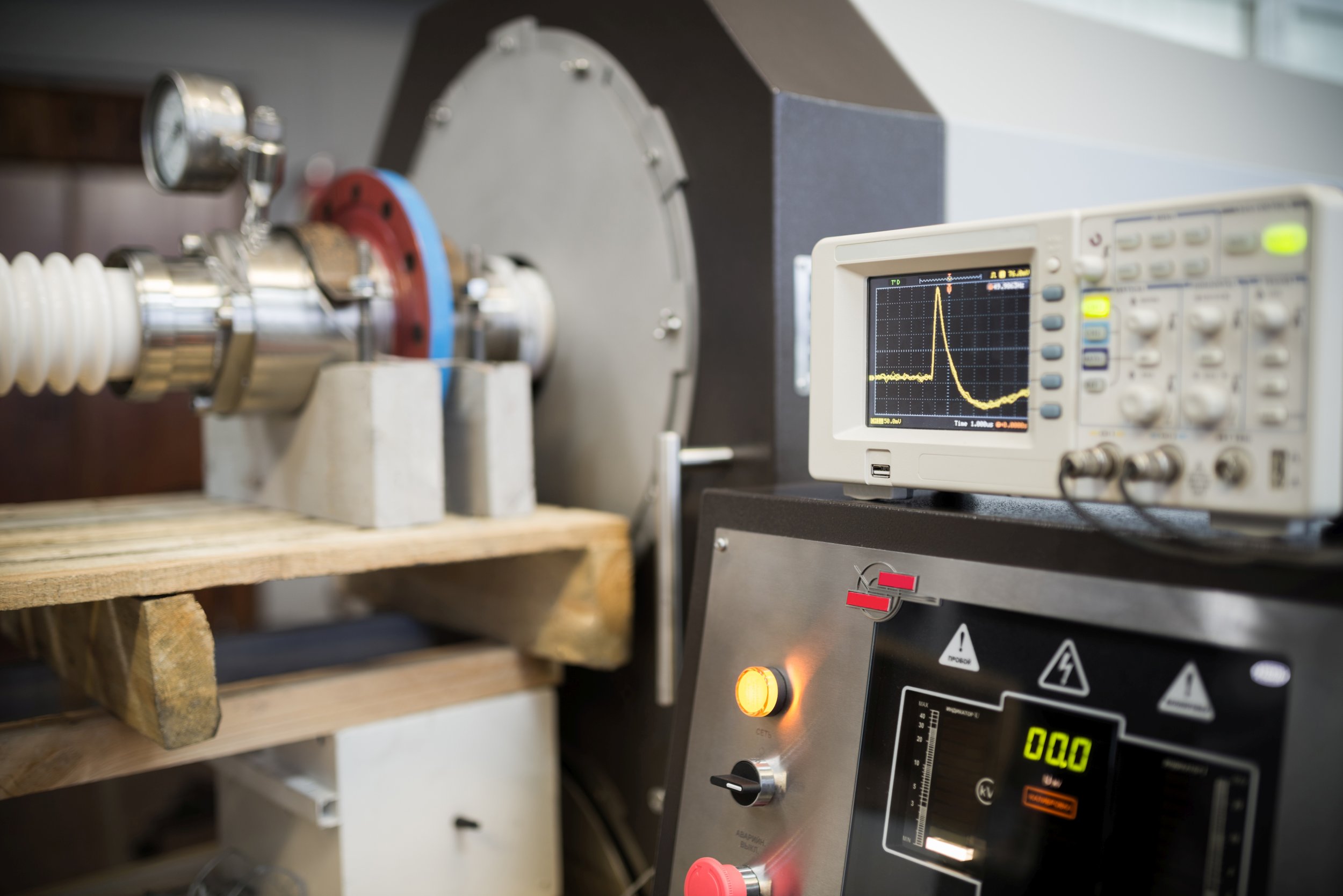
In industrial facilities -from manufacturing plants to mining operations to water utilities- the most reliable machines are not necessarily the newest ones. They are the ones being listened to. And the most powerful listening tool available to maintenance engineers today is vibration analysis.
This article is a deep dive into what vibration analysis actually is, how it works, and why it has become the gold standard for detecting equipment problems before they become catastrophic failures.
First: Why Do Machines Vibrate?
All rotating machinery generates vibration as a natural byproduct of operation. Motors, pumps, compressors, gearboxes, fans: every component that spins, reciprocates, or transmits force produces a characteristic vibrational “signature.”
Under normal conditions, this signature is remarkably stable. A well-balanced pump running at 1,450 RPM will produce the same vibration fingerprint day after day. But the moment something begins to degrade, bearing starts to wear, a shaft falls out of alignment, a bolt works itself loose, and the signature changes. Often subtly at first. Then progressively louder, until it announces itself as an unplanned breakdown.
The entire discipline of vibration analysis is built on a single insight: the change happens long before the failure. And that window between change and failure is exactly where predictive maintenance lives.
The Four Faults That Cause 90% of Rotating Equipment Failures
Research consistently shows that roughly 90% of mechanical failures in rotating equipment trace back to just four root causes. Vibration analysis detects all of them.
1. Imbalance
When mass is unevenly distributed around a rotating shaft (due to material buildup, wear, or manufacturing tolerances) the machine vibrates at its rotational frequency. In a vibration spectrum, this appears as a dominant peak at 1× RPM. Imbalance is one of the most common and easiest faults to detect, yet left unaddressed it accelerates bearing and seal degradation, creates fatigue stress on the shaft, and eventually leads to catastrophic failure.
2. Misalignment
When two coupled shafts are not properly aligned (either angularly or in parallel), they force each other into unnatural motion. This shows elevated vibration at 1× and 2× RPM in the axial direction. Misalignment is particularly destructive because it creates excessive forces on couplings and bearings simultaneously. A single misaligned motor-pump set can consume 15% more energy and destroy bearings in a fraction of their rated lifespan.
3. Mechanical Looseness
Loose foundations, worn bearing housings, or improperly torqued fasteners create a characteristic pattern of sub-harmonics and multiple harmonic peaks across the vibration spectrum. Looseness is insidious: it often develops gradually, making it easy to miss in manual inspections, but it dramatically amplifies the effects of any other fault present in the machine.
4. Bearing Wear
Bearings are the workhorses of rotating machinery, and they are the single most common failure point. As a bearing degrades, its rolling elements, inner race, outer race, and cage each produce specific fault frequencies that appear in the vibration spectrum. These “bearing defect frequencies” (BPFO, BPFI, BSF, FTF) are mathematically predictable based on bearing geometry and rotational speed, which means a trained system can identify not just that a bearing is failing, but which component of the bearing is failing and how urgently.
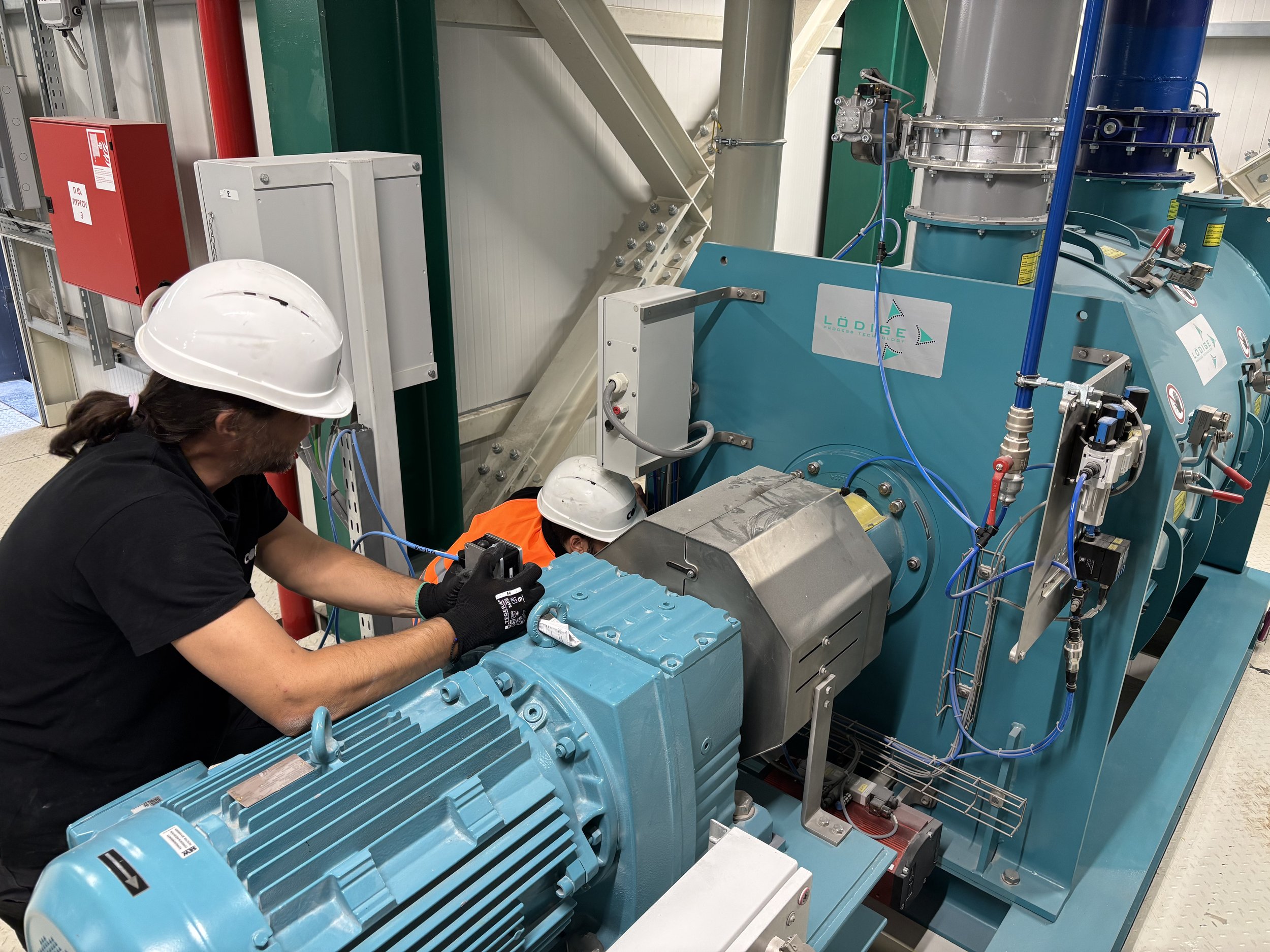
Installation of COREbeat
How Vibration Analysis Actually Works
Understanding the four faults is one thing. Detecting them reliably in a noisy industrial environment is another. Modern vibration analysis uses a layered approach.
Step 1: Data Collection
Vibration sensors (typically accelerometers) are mounted at key measurement points on the machine: bearing housings, motor end bells, gearbox covers. These sensors measure acceleration across a wide frequency range, capturing the full complexity of the machine’s behavior.
The critical distinction in modern systems lies in where and how often this data is processed. Traditional portable data collectors require a technician to physically visit each machine on a route, a process that might happen monthly or quarterly. Continuous, online monitoring changes this entirely: permanently installed sensors stream data in real time, catching faults the moment they develop rather than waiting for the next scheduled visit.
Step 2: Signal Processing — The FFT
Raw vibration data is a time-domain signal: a waveform that shows how acceleration changes over milliseconds. To extract meaningful diagnostic information, this signal is converted into the frequency domain using a mathematical technique called the Fast Fourier Transform (FFT). The FFT decomposes the raw signal into its constituent frequencies, producing a spectrum that shows exactly how much vibration is occurring at each frequency. This is the vibration analyst’s primary diagnostic tool - the equivalent of an X-ray for machinery. Peaks at specific frequencies are the fingerprints of specific faults.
Step 3: Advanced Analysis — Envelope Detection
For early-stage bearing faults, a standard FFT alone is often not sensitive enough. This is because the tiny, high-frequency energy generated by a bearing defect gets completely buried under the machine’s dominant low-frequency shaft vibrations and general background noise. This is where envelope analysis (also known as high-frequency resonance technique) provides a decisive advantage. A failing bearing generates brief, impulsive shocks as its damaged surface contacts rolling elements. Envelope analysis isolates these subtle impacts by through a specific process:
Bandpass-filtering the raw signal to isolate the high frequencies where the impact energy rings out,
Extracting the amplitude envelope (demodulation) to smooth out the signal,
Performing FFT on that envelope.
The resulting spectrum can detect bearing faults weeks or even months before they become visible in a standard vibration spectrum, dramatically extending the warning window available to maintenance teams.
Step 4: Trending and Diagnostics
A single vibration reading is useful; A continuous trend is transformative. When a system tracks the evolution of vibration levels and spectral patterns over time, it can distinguish between three critical states:
A stable machine operating normaly,
A slowly degrading machine with an early-stage fault,
A machine approaching imminent failure.
By mapping this progression, maintenance teams can schedule interventions at the optimal moment, not too early and not too late.
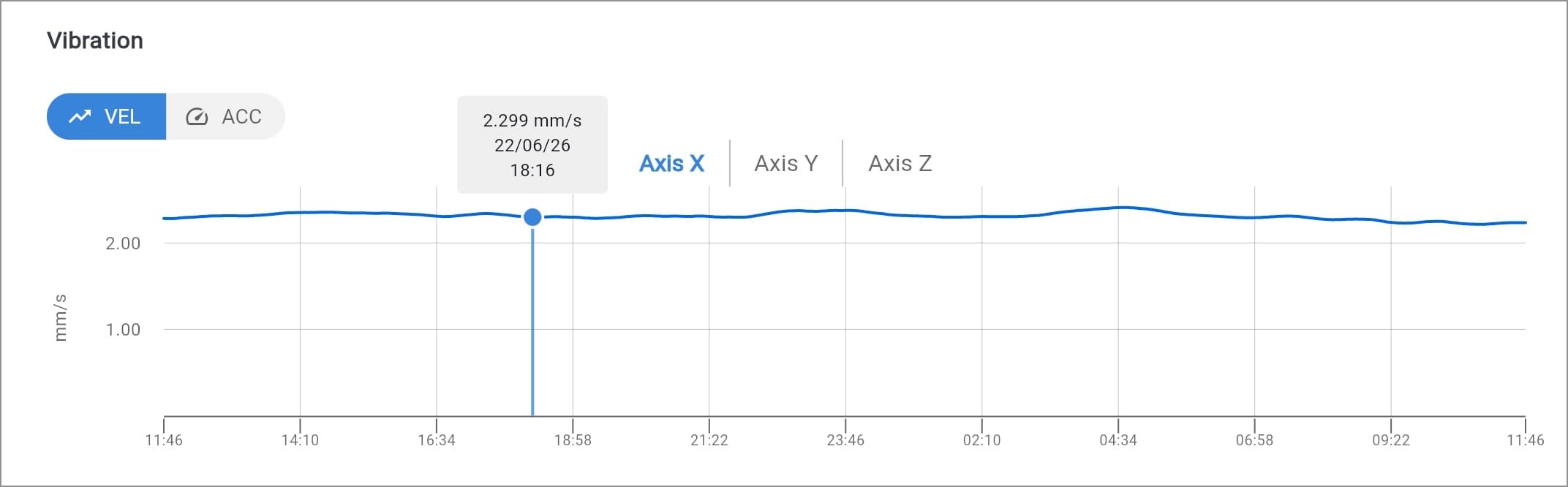
Vibration Analysis in the COREbeat UI
The Business Case: What Undetected Vibration Actually Costs
A landmark study by PwC and Mainnovation, surveying 268 industrial companies across Belgium, Germany, and the Netherlands, found that 95% of European companies already using predictive maintenance with big data analytics reported tangible, measurable results. The documented average improvements were:
9% average increase in equipment uptime (with top-performing companies achieving up to 25–30%)
12% reduction in overall maintenance costs
14% reduction in safety, health, and environmental risks
20% extension in the lifetime of aging assets
The logic is straightforward: a sensor installation that prevents a single catastrophic bearing failure -and the production loss that accompanies it- delivers a return that dwarfs its cost many times over.
From Analysis to Action: Where AI Changes Everything
Traditional vibration analysis required highly specialized expertise. A trained reliability engineer could spend hours interpreting a vibration spectrum, correlating frequency peaks with fault patterns, and formulating a diagnosis. This expertise is scarce, expensive, and not available around the clock.
Modern AI changes this equation fundamentally. Machine learning models trained on millions of vibration patterns can perform the same diagnostic reasoning in seconds—continuously, 24 hours a day, across hundreds of machines simultaneously. More importantly, they can detect the subtle, multi-dimensional patterns that precede failure long before any single frequency threshold is crossed.
This is the architecture behind COREbeat. Our beatBox Edge Devices are compact, IP67-rated IoT sensors and compute nodes that attach directly to critical machine points. They capture tri-axial vibration data continuously and perform the initial signal processing at the edge directly on the factory floor without relying on cloud connectivity for the millisecond-level decisions that matter most.

When the system detects an emerging fault, it doesn’t just trigger an alert. It generates an AI-powered incident report, in plain language, that tells maintenance teams exactly what is happening, which component is affected, and what action to take. “Bearing outer race defect detected on Pump #4 — schedule inspection within 7 days” is more actionable than an error code on a dashboard.
Our integrated AI Assistant goes one step further: operators can ask direct questions about machine behavior, maintenance history, and performance trends, receiving answers derived from real sensor data rather than manual log entries or engineering guesswork.
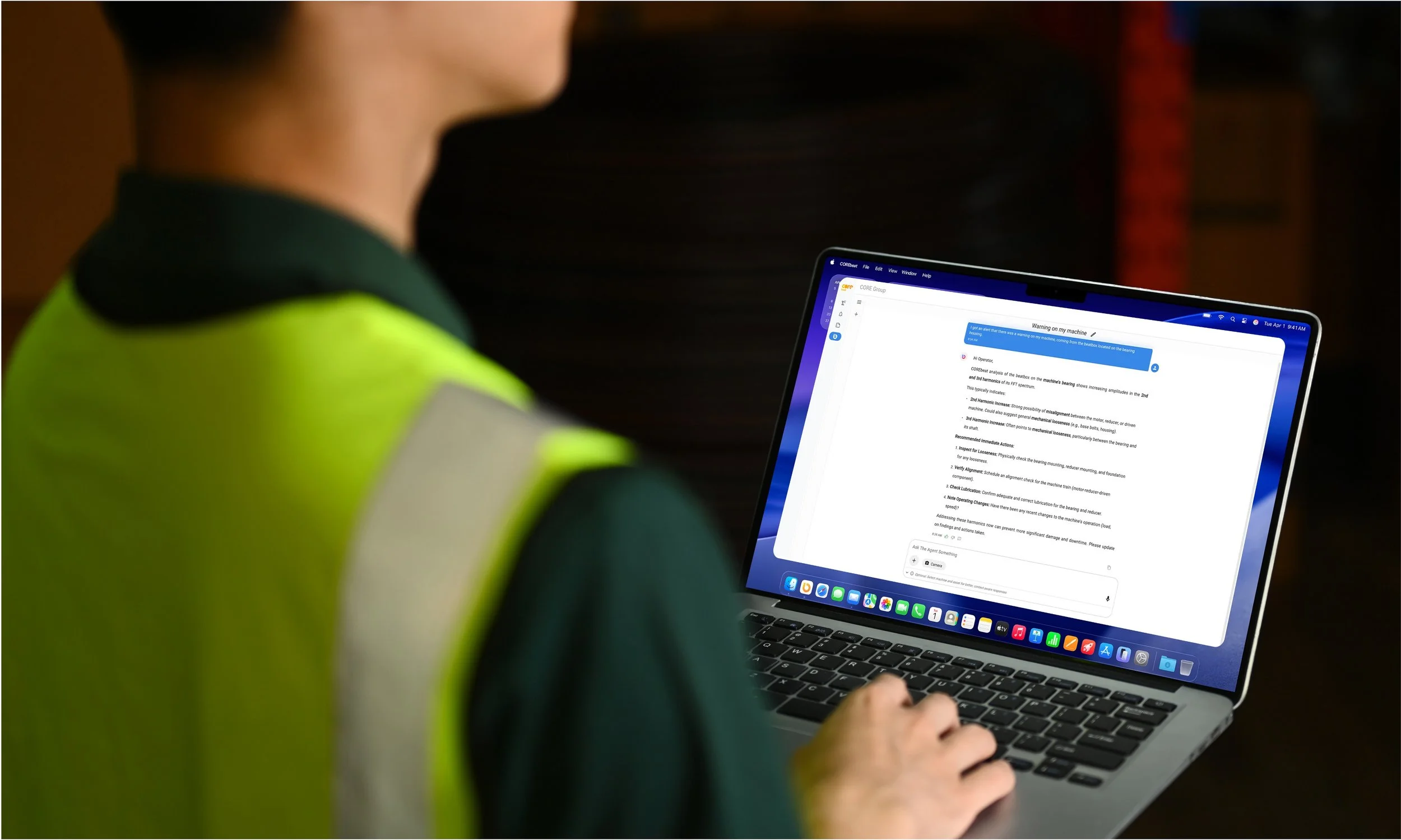
The AI assistant