Smarter Circular Economies Through Predictive Resource Flow Management
Smarter Circular Economies Through Predictive Resource Flow Management
Maria Tassi, R&I Project Leader & Dimitris Politikos, Research Data Scientist
Calculating...
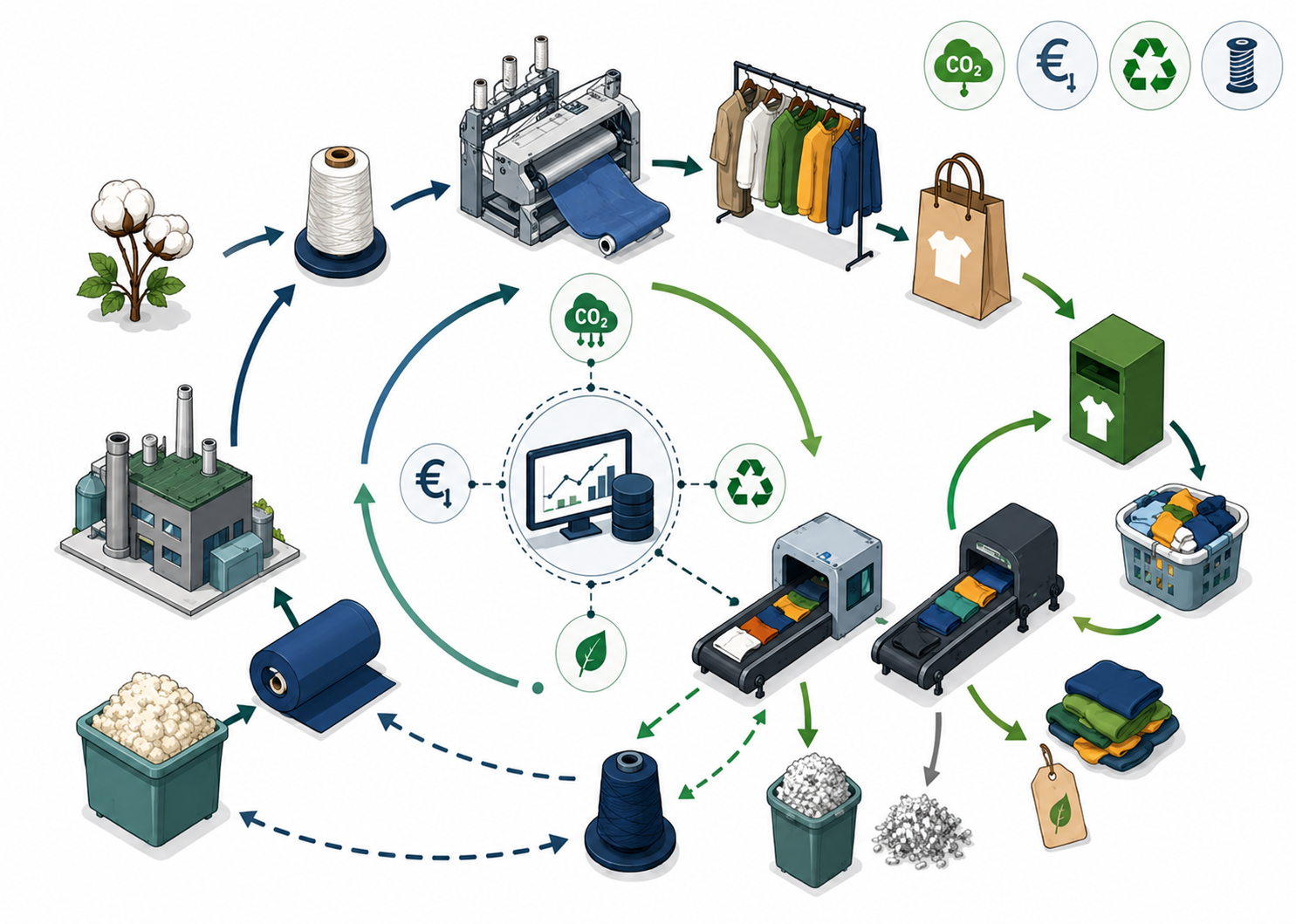
As industries and cities transition toward circular economy models, managing material and resource flows becomes increasingly complex. Circular ecosystems involve multiple stakeholders, interconnected value chains, fluctuating waste streams, varying recovery rates, and continuously changing operational conditions.
To address these challenges, CORE IC has developed the Prediction Resource Logistics Module (PRLM) within the THESEUS project. The PRLM is an advanced digital technology designed to support intelligent circular resource management by enabling industries and cities to analyse, predict, and optimise resource flows across circular economy ecosystems.
This article presents the technological foundations, innovation potential, and strategic value of the PRLM, highlighting how advanced modelling and optimisation techniques can support more efficient, resilient, and sustainable resource management. It also demonstrates how the technology builds upon CORE IC’s expertise in industrial digitalisation, AI-enabled optimisation, and sustainable transformation.
Why This Technology Matters
Traditional resource management approaches are often reactive and based mainly on historical monitoring. As a result, organisations struggle to predict future behaviour, coordinate recovery processes efficiently, and optimise circular operations in real time. This can lead to material losses, operational inefficiencies, increased costs, and missed sustainability opportunities.
The Prediction Resource Logistics Module (PRLM) addresses these challenges by introducing predictive analytics and optimisation capabilities into circular resource management. Instead of simply visualising historical data, the PRLM enables stakeholders to analyse material flows, evaluate future scenarios, identify bottlenecks, and optimise circular strategies.
The Technology at a Glance
The Prediction Resource Logistics Module (PRLM) is designed to analyse, predict, and optimise resource flows within circular economy ecosystems. The technology combines Dynamic Probabilistic Material Flow Analysis (DPMFA), predictive modelling, sustainability and circularity assessment, and optimisation algorithms to support intelligent decision-making.
At the core of the PRLM lies Dynamic Probabilistic Material Flow Analysis (DPMFA), an advanced evolution of conventional Material Flow Analysis (MFA). Unlike static MFA approaches, DPMFA introduces temporal dynamics, probabilistic modelling, and predictive system behaviour analysis. This allows the system to model how resource flows evolve over time while accounting for uncertainty, operational variability, and changing environmental conditions.
The PRLM enables organisations to:
• Analyse material stocks and flows
• Monitor recovery and recycling performance
• Predict waste generation trends
• Identify bottlenecks and inefficiencies
• Evaluate future operational scenarios
• Optimise redistribution and recovery pathways
• Improve circularity and sustainability performance
Unlike conventional monitoring platforms that mainly visualise historical data, the PRLM introduces predictive and adaptive capabilities into circular resource management. By combining predictive intelligence with optimisation techniques, the system supports proactive planning and more efficient circular economy operations.
Additionally, a THESEUS MFA Agent was developed by CORE-IC as a user-friendly intelligent assistant developed to support the results and functionalities of the Prediction Resource Logistics Module (PRLM).
It enables stakeholders to easily explore material flows, evaluate circularity scenarios, and understand the outcomes of complex analyses through simple natural language interactions. By combining automated material flow calculations, visual analytics, and document-based knowledge retrieval, the agent transforms technical modelling results into accessible and actionable insights, helping users make informed decisions without requiring expertise in Material Flow Analysis or optimisation techniques.
Demonstrated Value and Metrics
The PRLM introduces measurable value for circular economy ecosystems by enabling more intelligent coordination and optimisation of material flows.
The optimisation framework is designed to improve resource efficiency, reduce operational inefficiencies, and support more sustainable logistics and recovery processes. Within the THESEUS framework, the PRLM is being developed and validated through real circular economy use cases and material flow scenarios, supporting the progressive maturation of the technology toward operational deployment.
The current implementation of the PRLM represents the foundational architecture of the module. Throughout the THESEUS project, the optimisation framework, predictive models, and integration interfaces will be iteratively tested, calibrated, and enhanced based on pilot results and stakeholder feedback.
Technical Architecture and Methodology
The PRLM is a decision-support framework that combines Material Flow Analysis, sustainability assessment, and optimisation to support circular economy strategies. At the core of the PRLM lies Dynamic Probabilistic Material Flow Analysis (DPMFA), an advanced evolution of conventional Material Flow Analysis (MFA). Unlike static MFA approaches, DPMFA introduces temporal dynamics, probabilistic modelling, and predictive system behaviour analysis. This allows the system to model how resource flows evolve over time while accounting for uncertainty, operational variability, and changing environmental conditions.
Key capabilities:
Dynamic resource flow modelling: Simulates future scenarios and evaluates the impact of circular strategies.
Performance assessment: Monitors circularity, resource efficiency, material
recovery, and waste reduction.
Optimisation engine: Identifies optimal resource allocation strategies using Linear Programming considering operational and sustainability constraints.
Integrated data ecosystem: Connects information from stakeholders, infrastructures, and value chains.
To enhance accessibility, CORE IC has developed the THESEUS MFA Agent, an intelligent assistant that enables seamless interaction with the PRLM through natural language queries. Stakeholders can explore material flows, evaluate circularity scenarios, perform calculations, visualise results, and run optimisation analyses without requiring expertise in Material Flow Analysis.
The agent interprets user requests, selects the appropriate tools and LLM capabilities, executes the required actions (e.g., scenario comparison, optimisation, or data analysis), and delivers clear, actionable insights to support decision-making.
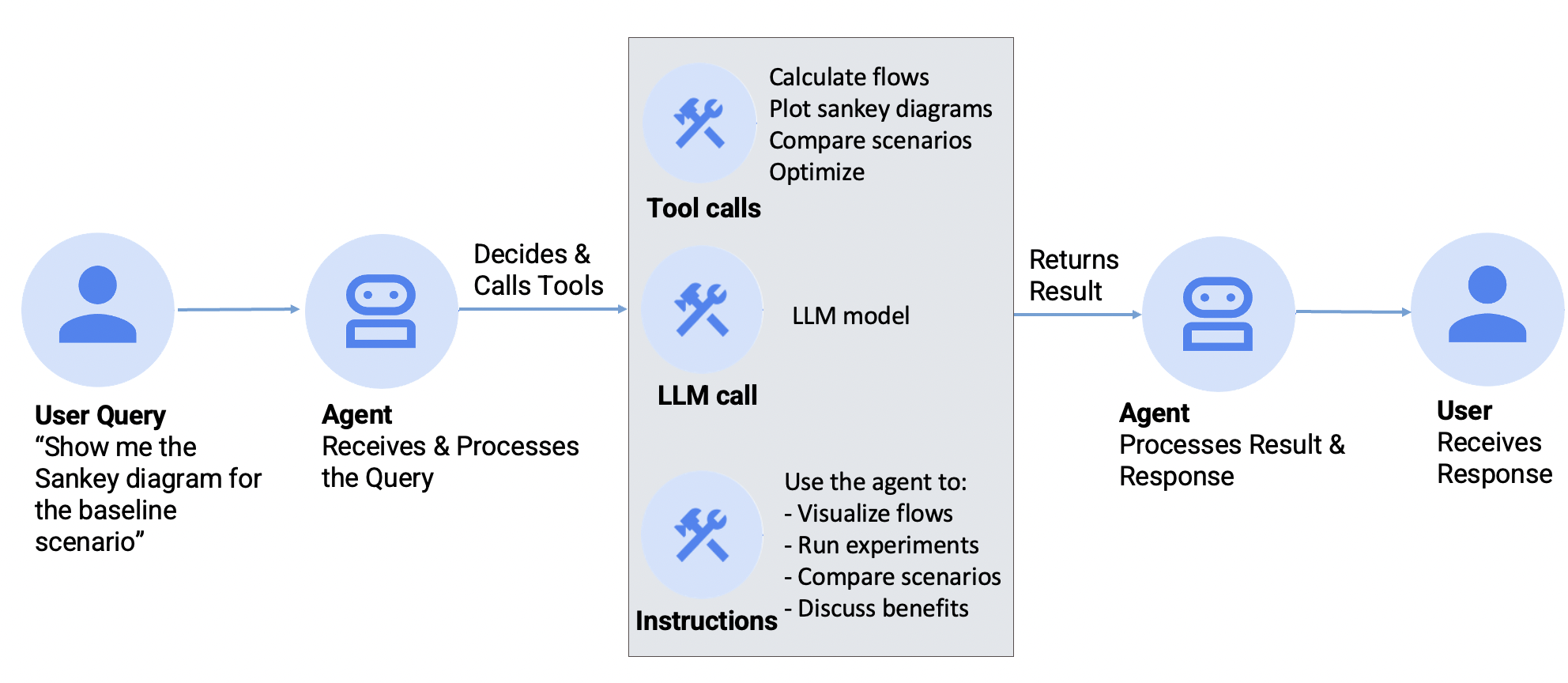
The PRLM architecture