Smarter Energy Decisions for Industry with Our EMS Suite
Ioannis Meintanis, AI Engineer & Dimitris Politikos, AI Engineer
Calculating...
Industrial energy costs are no longer determined only by how much energy a site consumes. They depend on when that energy is used, where it comes from, and whether the next investment in generation or storage will actually pay off. At CORE Innovation Days 3, we presented our Energy Management System (EMS) suite: a set of tools that turns operational data, market prices and asset constraints into actionable dispatch and investment decisions.
The problem
Most industrial sites already have meters, SCADA systems, weather feeds and electricity contracts. What they often lack is a single decision layer that brings these inputs together.
As a result, plants may continue operating as they always have, while price spikes appear only weeks later on an invoice. PV systems, CHP engines, batteries and grid connections are often optimised separately, even though their value depends on how they operate together. New assets may also be justified through rough estimates rather than hourly prices, efficiency losses and realistic dispatch strategies.
Without a credible baseline: what the site would have paid using grid electricity alone, the value of on-site generation remains an assumption rather than a measurable result.
The consequence is higher operating cost, missed self-consumption and capital invested in the wrong asset, or at the wrong size.
Who it is for
The EMS suite is designed for the people making these decisions:
Plant and facility managers, who need to know how much energy to purchase tomorrow and when to use it.
Energy managers and sustainability teams, who need credible savings reported against a defined baseline.
Engineering and operations teams, responsible for energy assets and their operating constraints.
Investment and project developers, deciding whether an investment into an energy asset should be made, and at what capacity and cost.
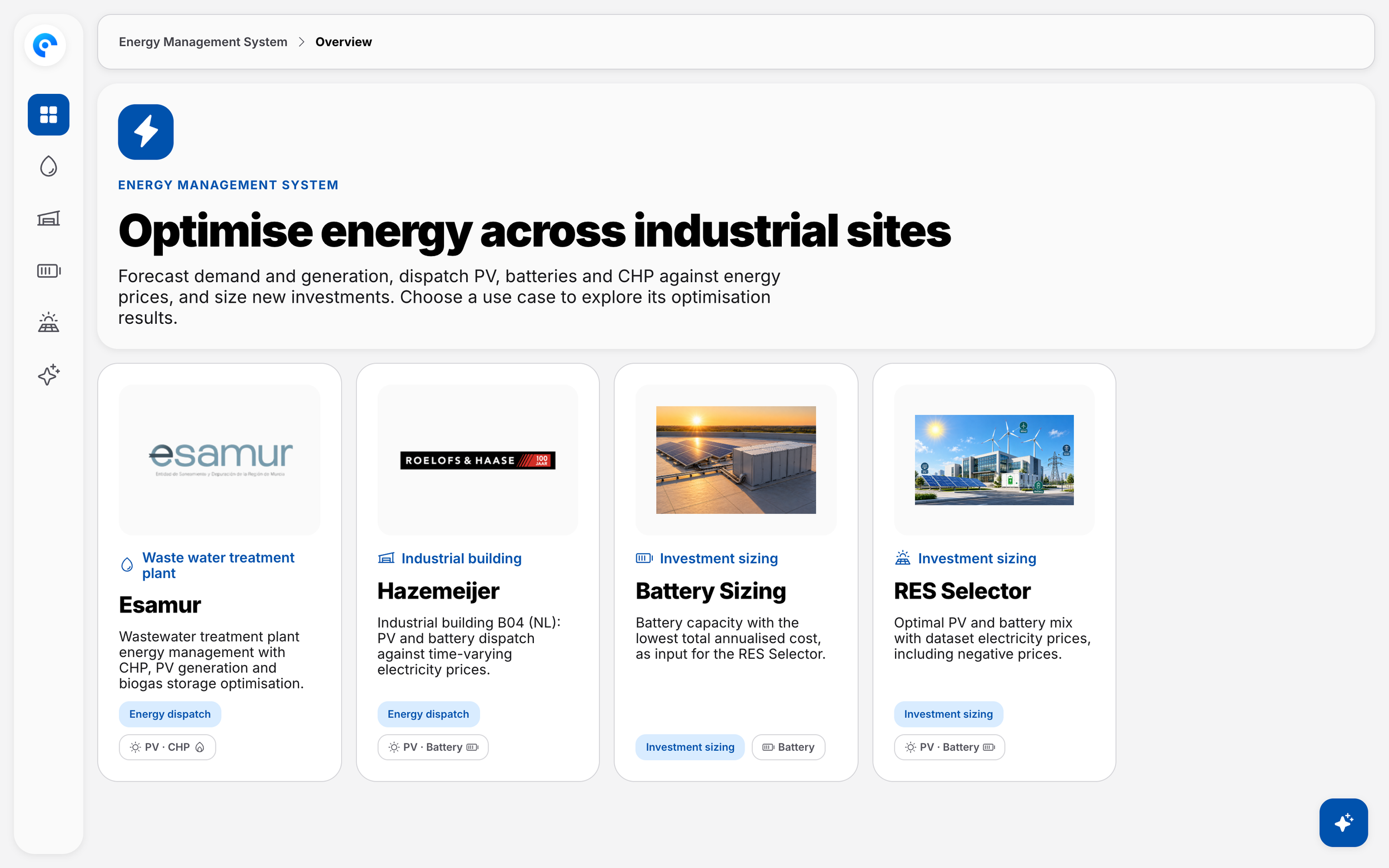
Esamur
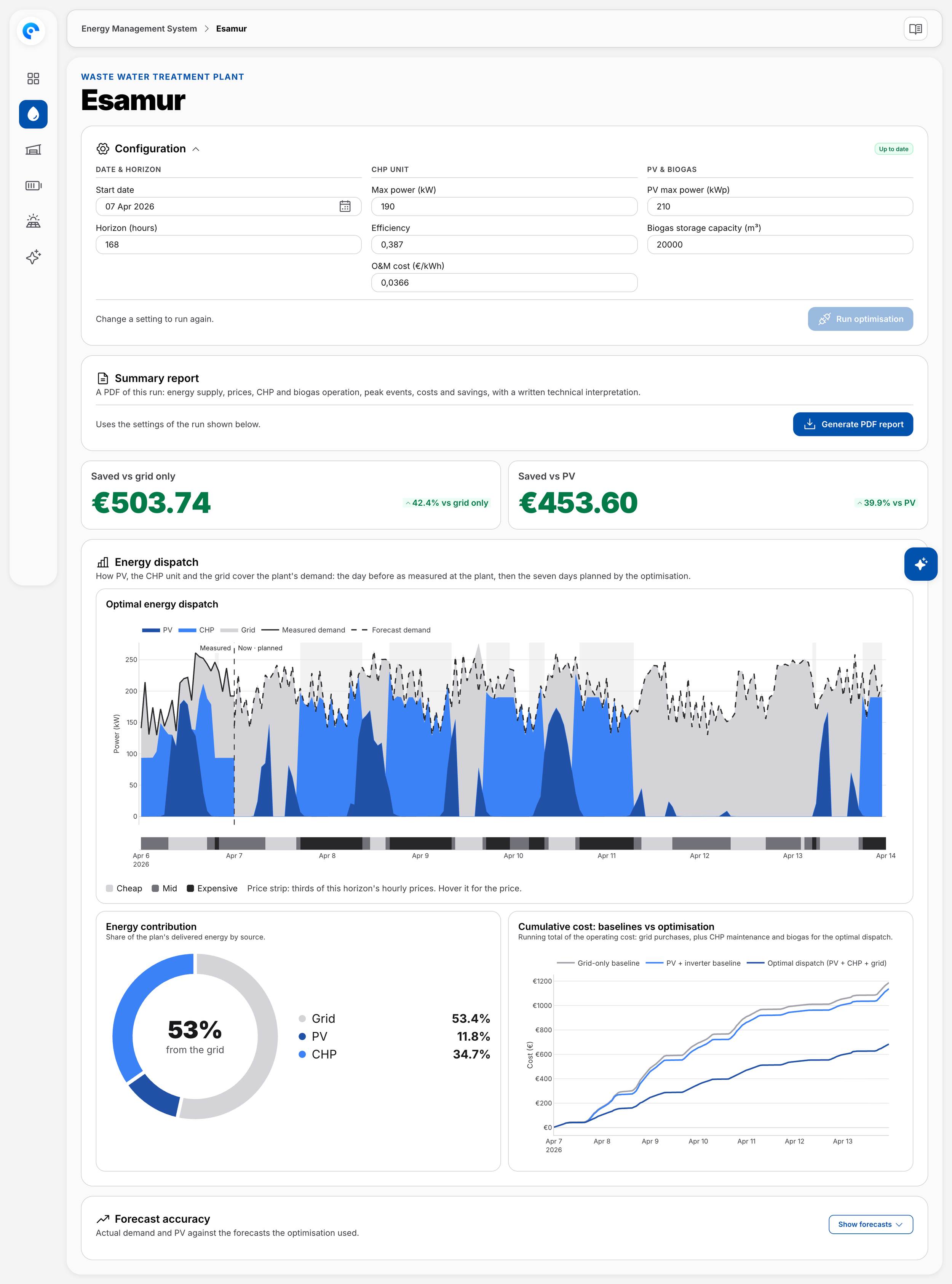
How should the grid, PV and CHP engine share the plant’s demand over the coming week?
Hazemeijer
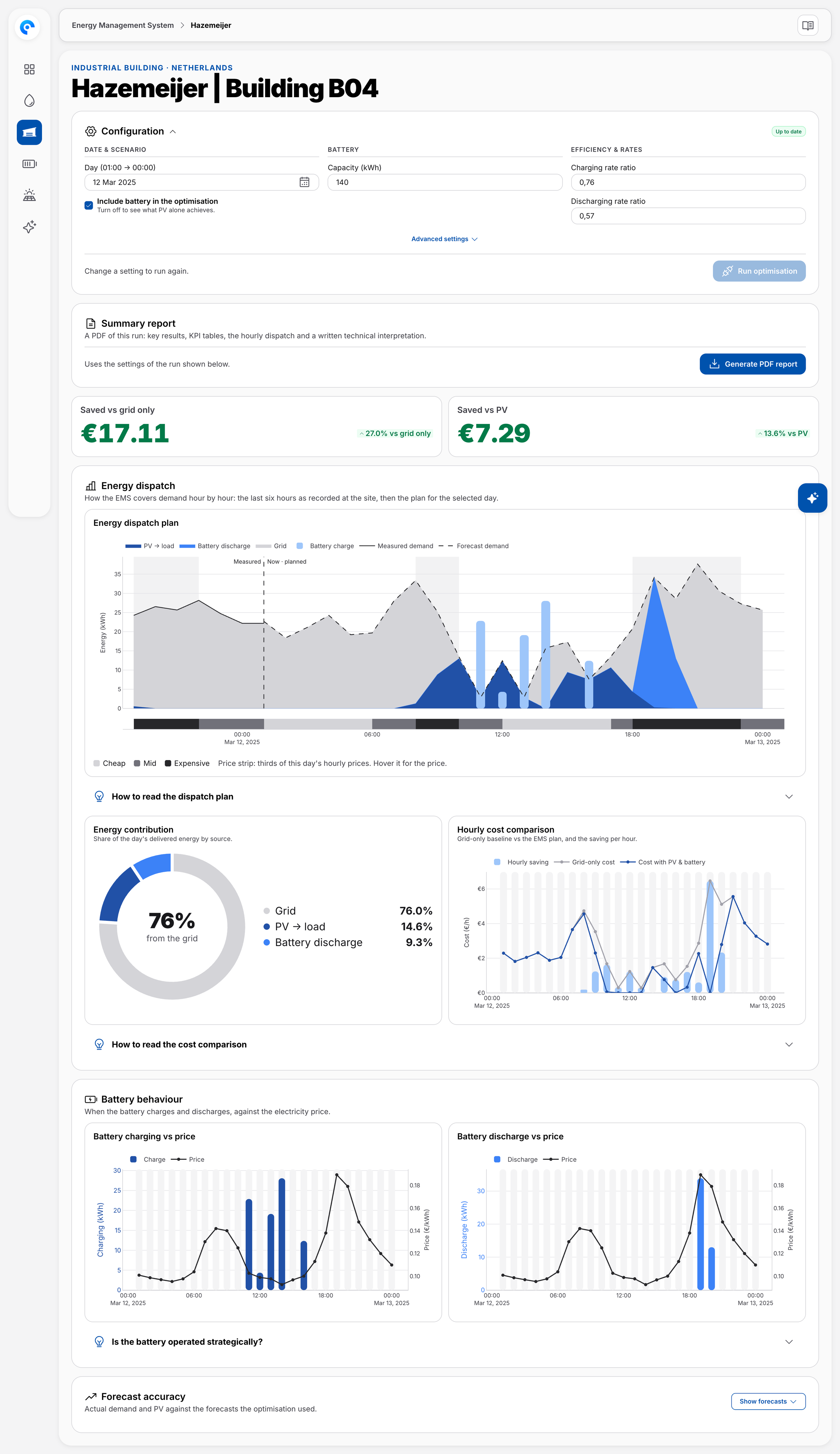
How should PV and a battery be dispatched against time-varying electricity prices over the next day?
Battery Sizing
What battery capacity minimises total annualised cost?
RES Selector
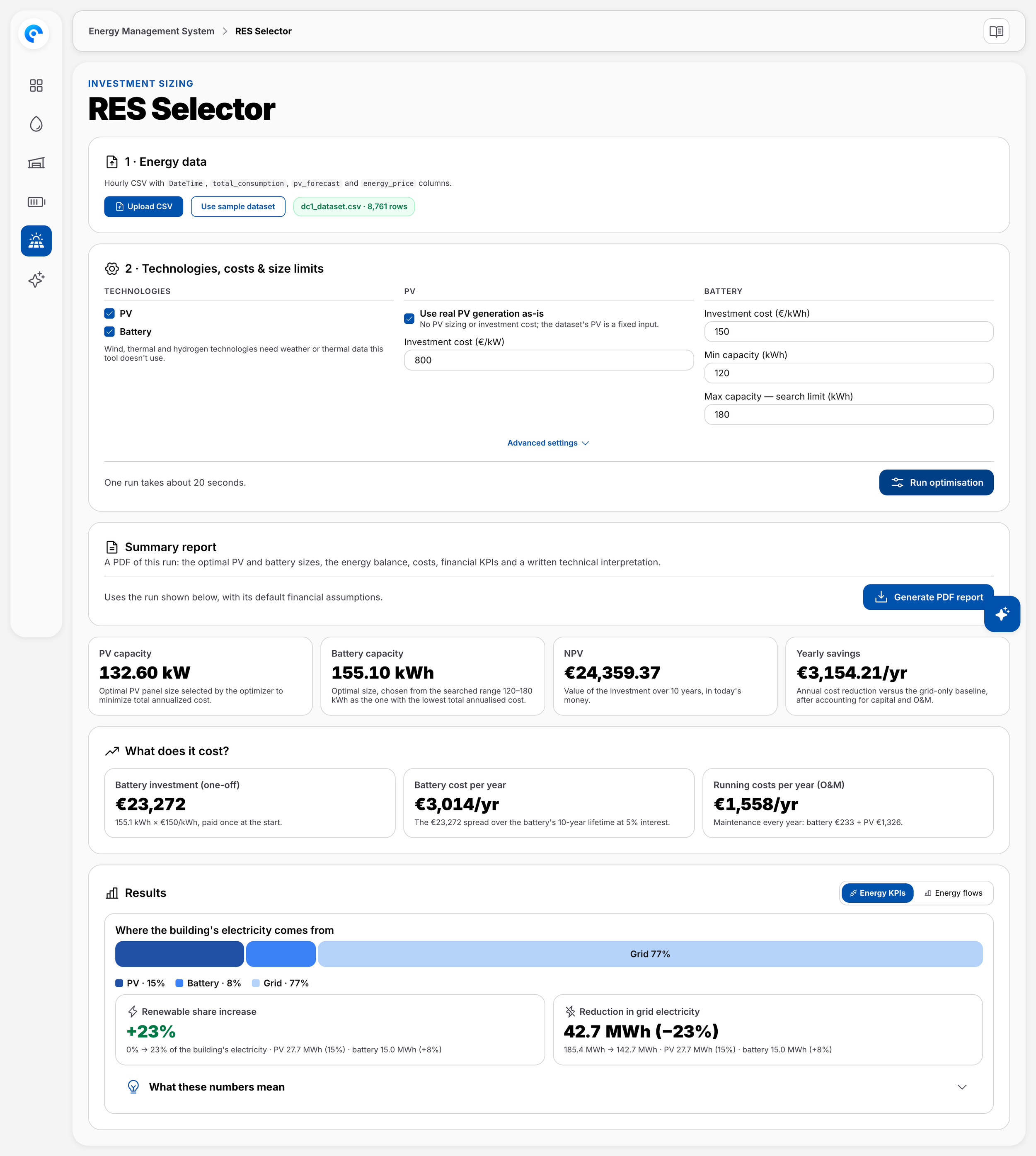
What RES assets and storage combination is optimal for a given energy profile and investment cost?
How it works
Each tool starts from a common data model: timestamped electricity prices, energy demand, available PV generation and asset constraints. Inputs can come from APIs, SCADA exports, metered building data, OMIE day-ahead prices, or an uploaded CSV file.
The system then combines historical measurements with day-ahead forecasts for demand, PV generation and electricity prices. These forecasts include an uncertainty envelope, so users can see not only a single energy plan but also the range within which it may perform.
On top of this sits an optimisation layer that minimises energy cost while respecting the physical and operational constraints of the site. Every optimisation scenario is backtested and compared with grid-only and PV-only baselines. Users can inspect both the measured past and the planned future side by side, making the recommendations transparent.
Decision support
The EMS suite includes an AI assistant that allows users to ask questions in plain language about energy optimisation, costs, savings, electricity prices and asset operation.
Users can also export results as a PDF report with one click. The report includes energy use, prices, battery operation, savings against baselines and a written technical interpretation, ready to share with internal teams, management or customers.
What we presented at Core Innovation Days 3
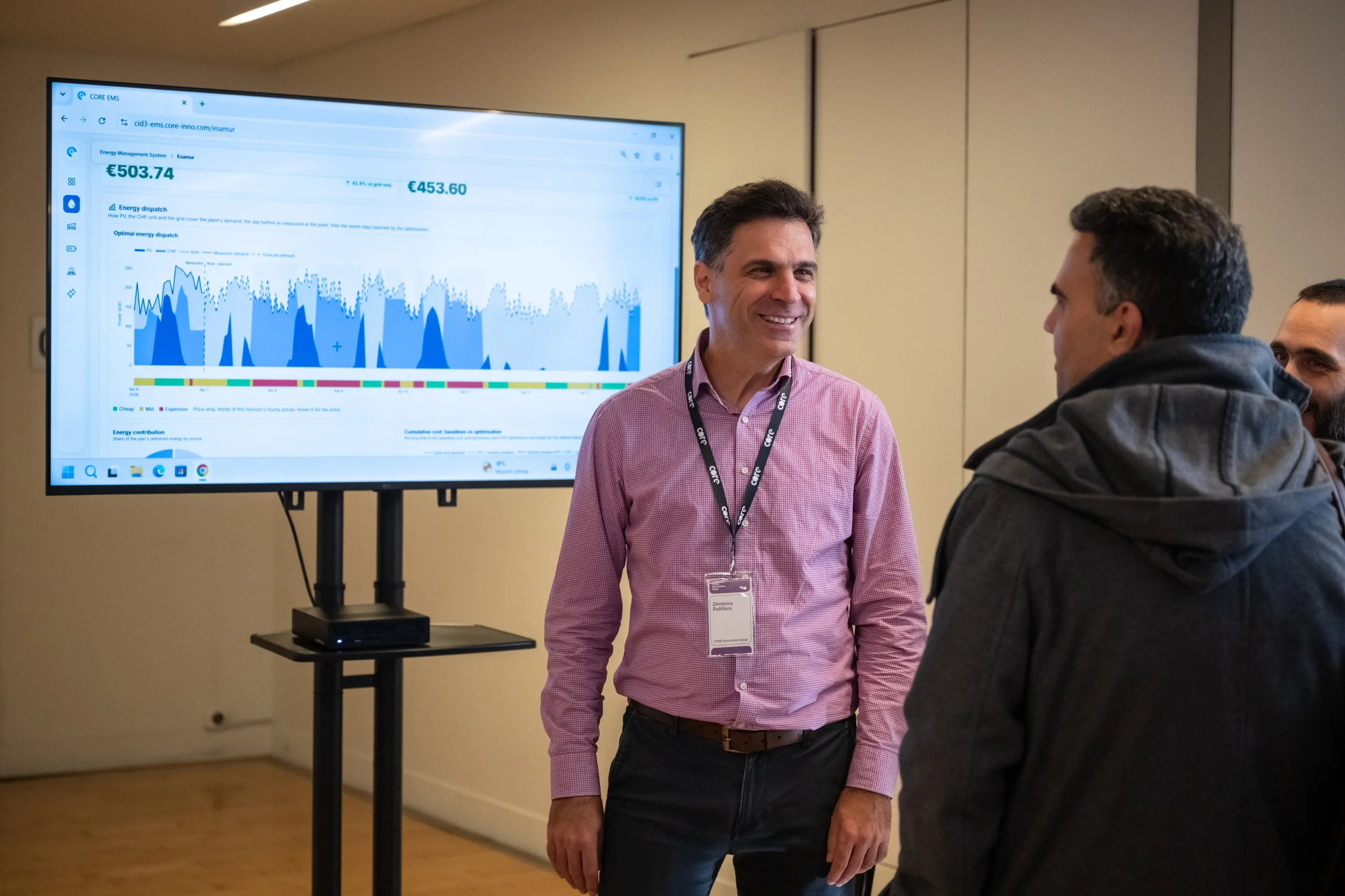
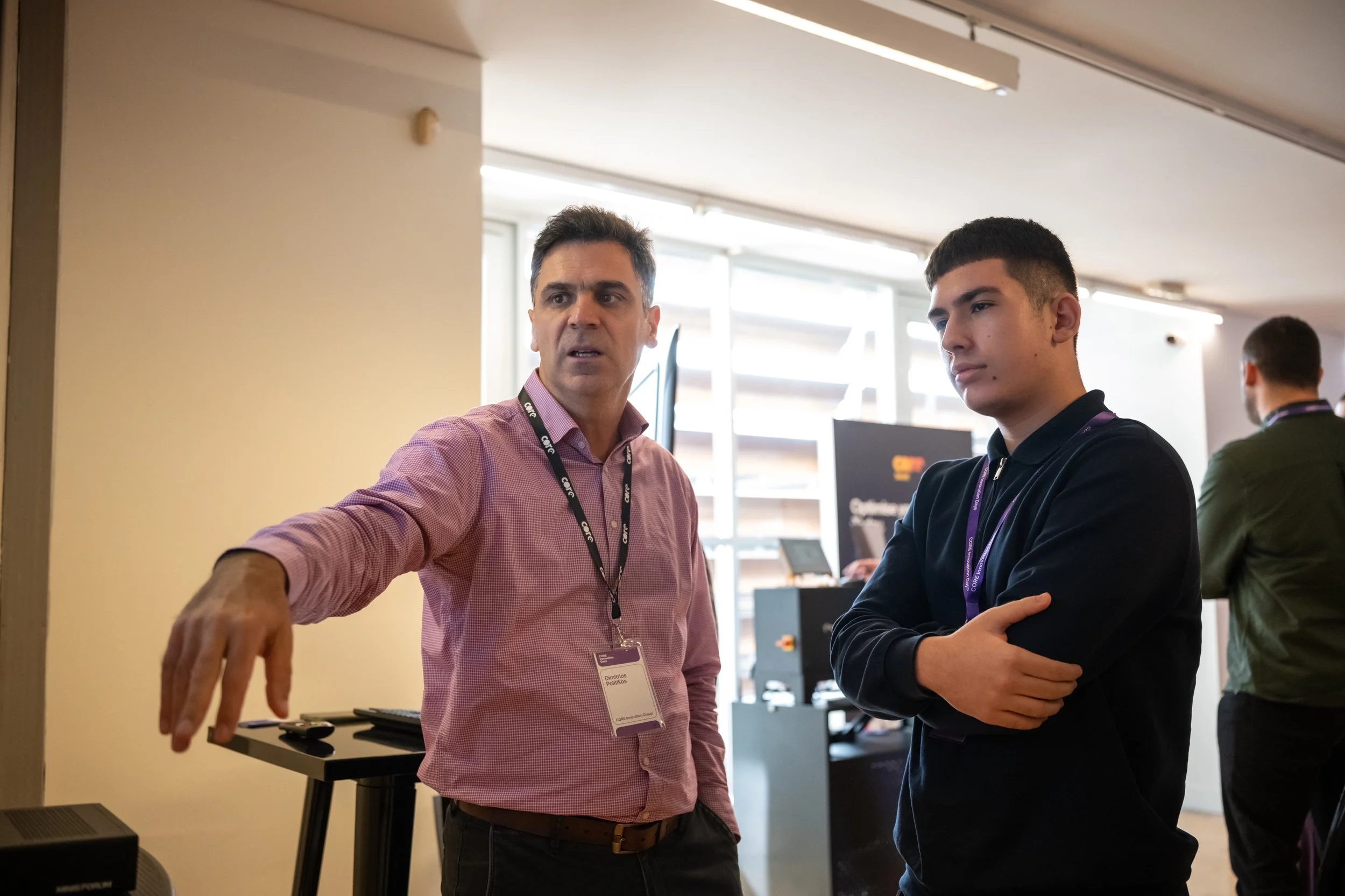
CORE Innovation Days 3 brought together professionals from industry, research and academia to explore Physical AI and Industry 5.0. During the live demonstration, each EMS use case executed in real time, while visitors asked questions, shared the operational challenges they face and discussed how the same approach could apply to their own sites.
The audience was largely technical, engineers and data specialists from industrial partners. The most valuable part of each conversation was the problem visitors brought with them: how plant’s operational constraints should really be modelled, what a battery is worth at their own price profile, and whether an investment case still holds once real hourly prices and round-trip losses are included.
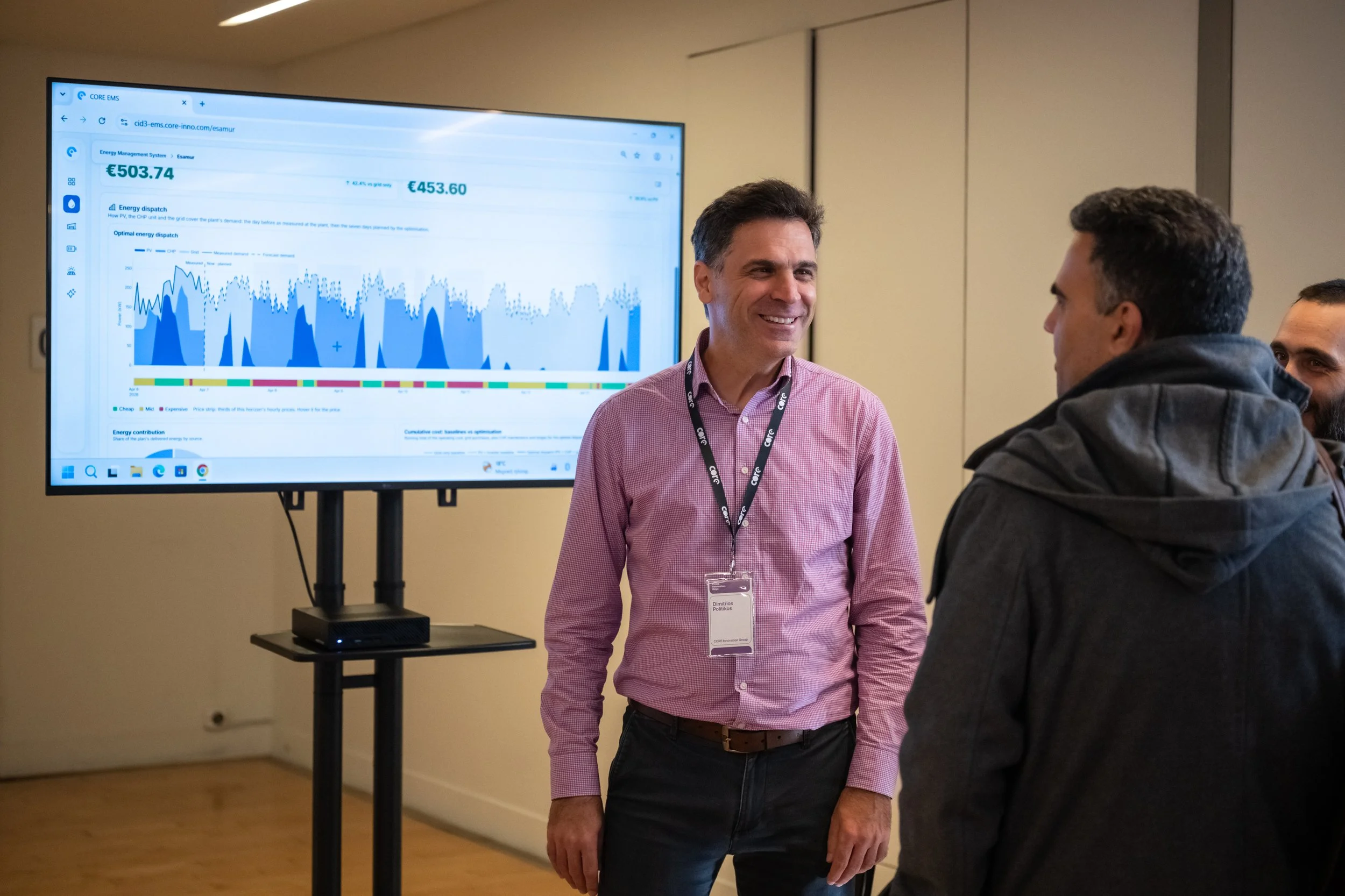

The EMS suite applied in ESAMUR planned a full week of dispatch for a wastewater treatment plant using real operational data. The optimised schedule reduced weekly electricity costs by approximately 40% compared with grid-only operation, while retaining most of that benefit against a PV-only baseline. The solution also steered the costly CHP engine away from the most expensive hours.
In Hazemeijer, the EMS demonstrated both daily and monthly planning scenarios for PV and battery dispatch against time-varying electricity prices. Visitors could see the battery shifting grid purchases away from high-price periods, with savings accumulating hour by hour.
Battery Sizing and RES Selector were demonstrated together as investment-planning tools, sized PV and battery capacity jointly, showing a clear reduction in grid electricity and an increase in renewable share from zero to approximately 25% of the building’s consumption.