Closing the Gap Between Energy Efficiency and Occupant Comfort: Introducing ECO-I
ECO-I: Energy and Air Quality Optimisation Interface
Aspa Kellari, AI Engineer
Calculating...
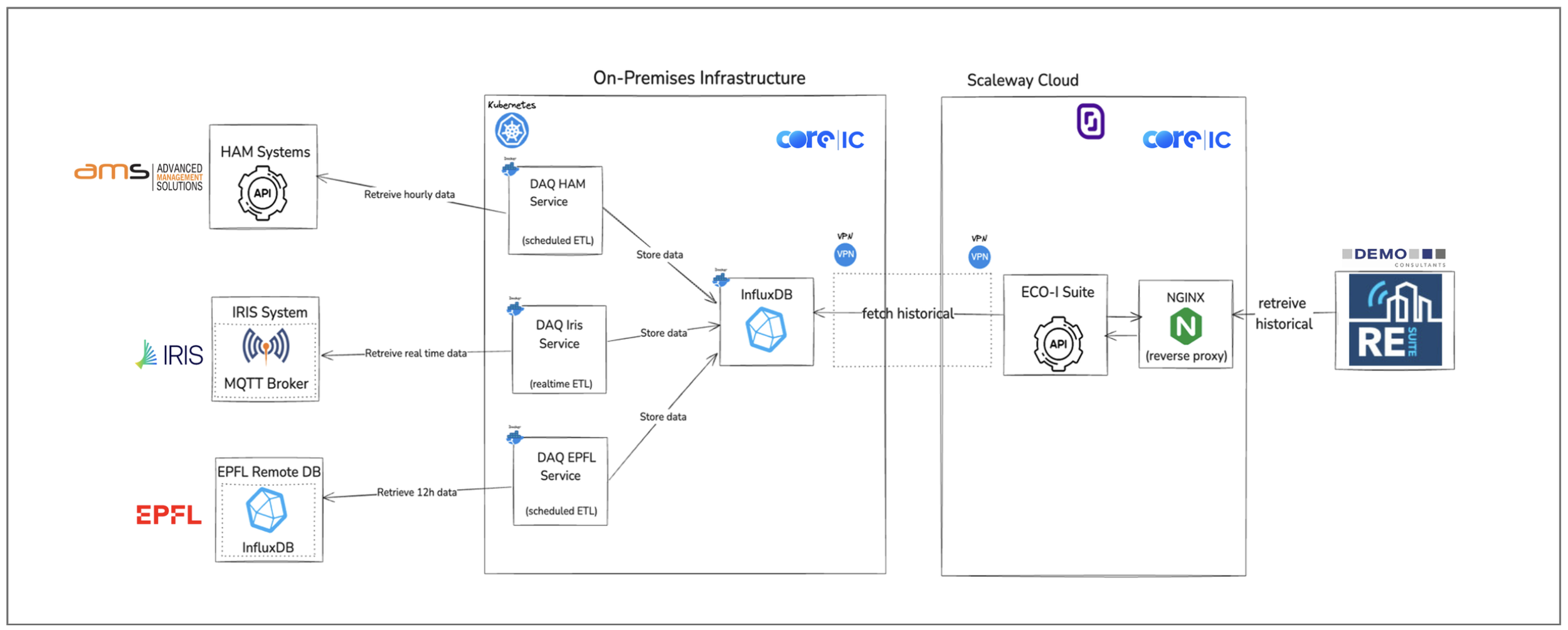
Energy efficiency and occupant comfort are too often treated as separate problems in building renovation. ECO-I, designed and developed by CORE Innovation Centre within the Horizon Europe project INPERSO, brings the two together in a single, open API platform. Here is what it does, why it matters, and how we built it.
The Problem
Buildings account for approximately 40% of energy consumption in the European Union and are responsible for around 36% of energy-related CO₂ emissions. Despite ambitious renovation targets embedded in the European Green Deal and the Renovation Wave strategy, the rate of deep energy retrofitting remains well below what is needed. A key barrier is the absence of integrated, data-driven systems that simultaneously address energy efficiency and occupant comfort - two goals that are often treated in isolation by existing solutions.
Traditional building management and energy monitoring systems suffer from fragmented data pipelines, proprietary interfaces, and limited analytical capabilities. They collect data but rarely act on it intelligently, and they rarely account for personalised comfort or indoor air quality. The result is a persistent performance gap between the theoretical efficiency of retrofitted buildings and their real-world operation.
The Solution
To close this gap, CORE Innovation Centre designed and developed ECO-I (Energy and Air Quality Optimisation Framework), within the Horizon Europe project INPERSO. ECO-I is a RESTful API platform that integrates data from Wireless Sensor Networks (developed by IRIS), Indoor Environmental Quality (IEQ) monitoring (developed by EPFL), and CORE-IC's own Multi-Stage Energy Consulting System (MuSECS) – an AI-driven engine for energy optimisation and Asset Health Monitoring. Together, these components form a single, interoperable interface that turns raw building data into automated, actionable decisions.
Why Existing Solutions Are Insufficient
Most current platforms either focus narrowly on energy monitoring without indoor environmental quality awareness, or they offer proprietary ecosystems that do not interoperate well with heterogeneous sensor networks and third-party analytical tools. There is no widely adopted, open, RESTful interface that unifies real-time IoT data ingestion, AI-driven energy forecasting, dispatch optimisation, anomaly detection, and IEQ index computation in a single platform accessible via standard APIs.
Why Now
The convergence of affordable IoT hardware, cloud-native infrastructure, and mature machine learning frameworks has made it feasible to build precisely this kind of integrated platform at scale. The INPERSO project, with its three geographically diverse European demo cases, gave CORE IC the real-world context and data to design, deploy, and validate ECO-I under realistic building renovation conditions.
The Technology at a Glance
What ECO-I Does
ECO-I is a cloud-hosted, RESTful API platform, architected end-to-end by CORE, that acts as the central integration layer for building energy and comfort management within the INPERSO project. Beyond MuSECS, the platform ingests supporting data from a wireless external sensor network and environmental databases across the three demonstration sites – energy meters, air quality sensors, and similar sources – via dedicated ETL pipelines into a centralised time-series database. This supporting data feeds directly into MuSECS's analytics and forecasting functions.
Data and analytical outputs are exposed through REST API endpoints grouped by function:
Raw Data Endpoints: direct access to sensor measurements from the demo sites.
Energy Insights Endpoints: statistical summaries derived from historical consumption data.
Energy Optimisation Endpoint: streams MuSECS's live optimisation results.
Asset Health Monitoring Endpoint: streams MuSECS's anomaly detection and condition-monitoring outputs.
IEQ Optimisation Endpoint: exposes IEQ index scores and improvement suggestions from the project's environmental monitoring pipeline.
Authentication Endpoint: manages secure access to the platform.