Breaking the "Tower of Babel" on the Shopfloor: A Multi-level Communication & Computation Platform for Distributed Manufacturing
Breaking the "Tower of Babel" on the Shopfloor: A Multi-level Communication & Computation Platform for Distributed Manufacturing
Maria Tassi, R&I Project Leader & Evangelos Foufikos, Backend Engineering Team Leader
Calculating...
Manufacturing is becoming increasingly connected, intelligent and distributed. Modern production environments combine robots, CNC machines, PLCs, sensors, inspection systems, edge devices, cloud platforms and AI applications, often supplied by different vendors and built on different communication standards. While this technological diversity creates opportunities for smarter and more flexible production, it also makes system integration one of the greatest challenges facing Industry 4.0.
To unlock the full potential of digital manufacturing, industrial assets must communicate seamlessly, exchange data in real time and support distributed computation across the factory. Achieving this without replacing existing infrastructure remains a major obstacle for many manufacturers.
To address this challenge, CORE Innovation Centre developed the Multi-Level Communication & Computation Platform within the European MODUL4R project.
Why Distributed Manufacturing Needs a New Approach
Most industrial facilities have evolved over many years. As a result, production lines typically combine legacy equipment with modern Industrial IoT technologies, each using different communication protocols, data models and computational capabilities. Integrating these heterogeneous systems often requires custom software, vendor-specific interfaces and extensive engineering effort, making production environments difficult to scale, maintain and reconfigure.
Traditional solutions primarily focus on system connectivity and data exchange. However, the next generation of manufacturing requires more than communication alone. As AI, distributed control and edge computing become increasingly important, factories also need to decide where data should be stored, processed and analysed, to meet latency, performance, privacy and resource requirements.
Fog computing has emerged as a key enabler of this transition by extending cloud capabilities closer to industrial assets. Positioned between Edge devices and Cloud infrastructures, it bridges the gap between local operations and centralised services, enabling low-latency processing, reducing unnecessary data transfers and improving system resilience. By allowing computational tasks to be executed close to the production process, Fog computing supports faster decision-making while maintaining seamless integration with enterprise and cloud applications.
The Multi-Level Communication & Computation Platform (MCCP) addresses both challenges by combining industrial communication with distributed computation management in a single modular platform.
A Unified Communication and Computation Platform
The MCCP provides a common digital infrastructure that enables heterogeneous industrial systems to communicate, share information and execute software services across multiple computational layers. Its architecture spans three complementary environments:
Edge, where production equipment, PLCs and sensors are directly connected and low-latency operations are performed.
Fog, where local orchestration, workload management and near-real-time processing optimise industrial operations close to the shopfloor.
Cloud, where computationally intensive services, long-term data storage, artificial intelligence and enterprise integration are deployed.
The Fog layer plays a central role in the multilayer architecture by bringing computation closer to where data is generated. Rather than transmitting every operation to the Cloud, Fog nodes execute time-critical services locally, reducing communication latency, minimising bandwidth consumption and ensuring that manufacturing processes continue even when cloud connectivity is limited. This distributed processing approach enables faster response times, improves operational resilience and makes more efficient use of available computational resources.
Instead of treating these environments independently, CORE IC’s fog orchestrator coordinates them as a unified ecosystem, allowing applications and services to execute where they are most efficient while maintaining continuous interoperability throughout the production system.
This distributed architecture allows communication and computational services to be deployed across Edge, Fog and Cloud according to the needs of the manufacturing environment. By coordinating these layers, the MCCP provides a flexible infrastructure that supports real-time industrial communication, distributed service execution and scalable integration with enterprise and cloud applications.
Modular, Scalable and Technology-Agnostic
The MCCP activates the capabilities of containarisation and Continuous Integration and Continuous Delivery/Deployment (CI/CD) to allow applications to be added, updated and even scaled or relocated significantly improving flexibility and maintainability. The platform supports widely adopted industrial communication standards, including MQTT, REST APIs and OPC UA, enabling seamless integration between operational technologies (OT), information technologies (IT) and cloud services.
Unlike conventional solutions that mainly facilitate communication, the MCCP also orchestrates computational workloads. This enables manufacturers to deploy intelligent applications where they deliver the greatest operational benefit while optimising resource utilisation and system performance.
By providing both communication and computation capabilities, the MCCP creates the digital foundation required for advanced Industry 4.0 applications. The platform supports distributed control, production monitoring, predictive maintenance, quality inspection, digital twins and AI-driven decision support by ensuring that data, services and computational resources remain available throughout the manufacturing environment.
As factories increasingly adopt software-defined production, autonomous systems and industrial AI, such distributed infrastructures become essential for building flexible and resilient manufacturing ecosystems.
Demonstrated in Industrial Manufacturing
The MCCP has been successfully developed and validated within the MODUL4R project through multiple industrial manufacturing scenarios involving distributed production systems, quality inspection, metrology and production logistics. The platform demonstrated its ability to integrate heterogeneous industrial assets, orchestrate distributed software services and enable secure communication across Edge, Fog and Cloud environments.
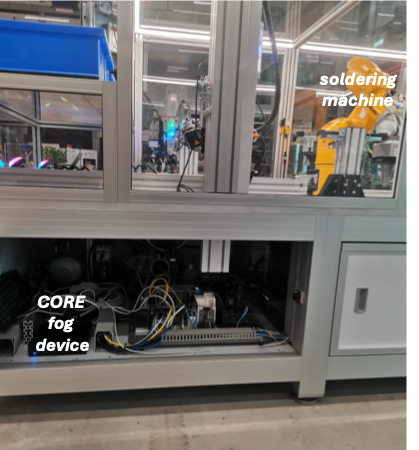
Fog device installed in SSF’s premises.